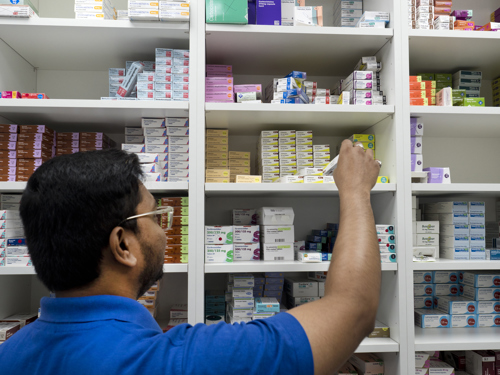
The NPA has called on the new Health Secretary to publish an urgent action plan to tackle the growing problem of medicine shortages and improve the UK’s resilience to medicine supply disruption, which blights pharmacies daily and causes undue stress and anxiety to patients as estimates revealed the sheer scale of medicines impacted by shortages.
New NPA analysis of Department of Health issued Medicine Supply Notifications (MSNs), published when a medicine is no longer in supply or there are supply constraints in place, found that 14 current MSNs could have had an impact on around 6.4 million prescription items a month this year.
MSNs have been issued for a number of commonly prescribed medicines this year affecting millions of patients, including a number of strengths of the blood pressure medicine Ramipril, the pain killer co-codamol and forms of the HRT medication Estradot.
Pharmacies frequently encounter concerned patients who have visited multiple pharmacies or travelled significant distances to get hold of the medicines they depend on.
Although delays to medicines can be frustrating for patients, who currently have to wait for prescriptions to be amended by their GP before collecting them, pharmacies are warning that for some it can pose a serious risk to patient safety.
This includes recent shortages for time critical medicines, including shortages of certain brands of insulin, Nabilone, a treatment to manage the side effects of Chemotherapy and Creon, a medicine that helps those with Cystic Fibrosis and Pancreatic Cancer digest food.
Pharmacies have urged the government to publish its consultation response, which closed nearly a year ago, to allow pharmacists to make substitutions to prescriptions when a medicine is not in stock.
They are prevented from making any changes to a prescription in the majority of cases, even to switch tablets to capsules or an ointment to a cream, by legislation that dates back to before the moon landings in 1969.
The NPA also warned of spiralling prices for medicines due to the impact of recent global shocks ,including the war in the middle east, frequently forcing pharmacies to dispense NHS medicines at a loss.
Volatility in medicine prices hit pharmacies, who have to buy NHS medicines on the open market, and can act as an early warning of supply issues as demand spikes or supply is constrained.
The Department of Health have broken records this year with the number of price concession they have issued, a mechanism used when the cost of medicine surges in price, with rates of concessions at their highest ever levels.
245 price concessions were issued for medicines in October 2026, compared to 100 in October 2025. The cost of Levothyroxine, a common thyroid treatment, has increased by more than 18 times between October 2025 and October 2026, rising from 18p to £3.29.
Similarly, the antibiotic Oxytetracycline is now 91 times higher than it was in January 2024, rising from 57p to £51.89.
Olivier Picard, Chair of the National Pharmacy Association said:
“This is shocking data which shows that millions of prescription medicines which patients depend on are being impacted by supply challenges every month.
"Despite government claims that the situation with medicine supply may be improving, this simply does not match the reality that pharmacies and the patients they serve are seeing on the ground.
“Problems with medicine supply can not only cause significant anxiety and frustration for patients but also can pose a serious safety risk, particularly for time critical medicines such as insulin and some antiepileptic treatments.
“We are looking at a perfect storm of medicine supply challenges coupled with soaring prices with pharmacy owners all too often footing the bill of our medicines.
“The new Secretary of State must grip this problem head on. This includes overturning mad rules that stop pharmacists from making any changes to a prescription when a medicine is out of stock, forcing a patient to go back to their GP.”


