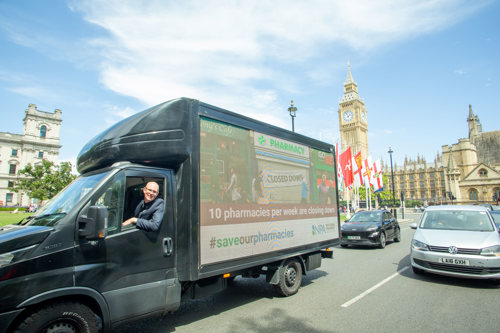
Over 280,000 people, the equivalent of a city the size of Newcastle Upon-Tyne, have seen their local pharmacy close in the first eight months of this year, new NHS data shows.
Analysis by the NPA of monthly NHS figures show that 51 high street pharmacies have added to the “tidal wave” of branches shut for good in England due to chronic underfunding between January and the end of August 2026, 2 a fortnight, hitting at least 280,000 patients.
The startling toll of closures includes 31 pharmacies on a Government programme to maintain vital access to medicines in healthcare shortage areas have shut for good, despite the government providing the sector with its second uplift in a decade in May.
The NHS Pharmacy Access Scheme provides additional funding to ensure there is access to pharmacy services in communities where there is no alternative nearby.
Today NPA leaders, who represent around 6,000 community pharmacies across the country, urged the government to fundamentally reform the NHS’s contract with pharmacies which means many pharmacies cannot rely on NHS income to keep them afloat. They called on government to close the £2 billion funding gap facing pharmacies.
Pharmacies lost to patients include:
· The closure of a former Lloyds Pharmacy in Long Rock, Penzance. This has left patients with a 1 hour 20 minute journey by public transport to access their nearest pharmacy on a Sunday, a 17 mile round trip.
· In Bishops Lydeard in Somerset, where the closure of the local pharmacy has left patients with a 10 mile round to trip to their nearest alternative. On the weekend, this is a 1 hour 6 minute journey on public transport.
· In Barnwood, Gloucester, where the closure of a Lloyds Pharmacy has left patients with a 50 minute walk to their nearest pharmacy on a weekend or 1 hour 10 minute round trip by public transport.
· In Bodmin in Cornwall where the closure of the Asda pharmacy has left patients with a 16 mile round trip to their nearest pharmacy open on a weekend, 1 hour 10 minutes on public transport.
Closures have forced patients to travel significant lengths to access emergency prescriptions as well as contraception and clinical advice, particularly on a weekend, patient groups and pharmacies have warned.
This risks putting pressure on other parts of the health system, with some patients potentially choosing to visit Urgent Care or even Accident and Emergency departments instead.
A ‘tidal wave’ of pharmacies have shut since 2017, with a whopping 1500 pharmacies shutting when funding was first cut to pharmacies by the previous government. This has affected patients access to vital prescriptions and health advice, particularly in isolated rural communities.
9.9 million people have seen their local pharmacy shut, around a fifth of the adult population of England.
The relentless toll of closures has taken the network to its smallest level in 20 years. The NPA have warned the government not to accept the permanent closure of pharmacies as the ‘new normal’ in the NHS.
Around 90 per cent of an average pharmacy’s work is funded by the NHS, including covering the cost of dispensing prescriptions and services such as vaccinations and Pharmacy First.
Pharmacies have seen a real terms cut of 40 per cent to their funding since 2016, despite recent uplifts.
Olivier Picard, Chair of the National Pharmacy Association said:
“These are depressing figures and demonstrates the work to stabilise the pharmacy network that millions of patients depend on is not done yet.
“We need to act to prevent the permanent closure of pharmacies becoming the new normal at a time when Government and the public wants more care closer to people’s homes
“Patients are being forced to travel long distances to access the medicines and support they need, particularly on weekends.
“It is particularly concerning to see closures of pharmacies that have been singled out for additional support due to their importance to the patients that use them and the lack of available alternatives in those areas.
“We recognise this government has provided pharmacies with desperately needed funding uplifts, but much of this had to go out the door to meet soaring costs including business rates and national living wage leaving pharmacies facing a yawning gap between their costs and the funding they receive from the NHS.
“We want to work with the government to fundamentally reform the pharmacy contract to achieve Ministers’ ambitions to bring care closer to home and end pharmacies being forced to dispense medicines at a loss.”
William Pett, Interim Director of Policy and External Affairs at Healthwatch, said:
“People rely on their local pharmacy for timely advice and essential medication, so closures are a real worry. We hear from people about longer journeys to find an open pharmacy, particularly in rural areas, and this is particularly difficult for those with limited mobility or no access to transport. It is no surprise that some people end up turning to other parts of the NHS when they cannot get the help they need in their community.
“Our own research has shown that temporary and unplanned closures have disrupted care and caused anxiety for patients across the country. A plan for the future sustainability of community pharmacies is essential so the public can rely on consistent access to medicines and advice.”